FicarPasso 2
Mangueira de jardim de 30 m com carreto
Why: tem de chegar a toda a volta da casa para regar paredes, telhado e 10 m de terreno.
Essential guide · Base level · 11 min
How to clear the 50 metres around your home, decide whether to leave or stay, and what to do at home, in the car or on foot when fire approaches.

The essentials, in four points.
around the house, free of scrub and with thinned trees. It is what protects a home most — and next to forest, Portuguese law requires it.
If you decide to leave, leave before the fire arrives. On the road, in smoke and flames, is where most people die.
If you stay at home: wet the walls, roof and 10 m around, close everything and shelter on the side away from the fire.
If you get an evacuation order — a Civil Protection text, authorities on the spot or the village safety officer — follow it at once.
Portugal is one of the European countries hit hardest by wildfires, and fires increasingly reach homes, villages and roads. On 17 June 2017 the Pedrógão Grande fire killed 66 people. According to the Independent Technical Commission appointed by Parliament, 47 died on the EN 236-1 road or the roads leading to it — inside their cars or next to them, trying to escape.
The lesson is harsh but clear: the decision to leave has to be made early, and a well-prepared house is a far better shelter than a car caught in smoke. This guide shows how to prepare your home before summer, how to decide between leaving and staying, and what to do in each case.
Surrounded by scrub and forest, far from firefighters. The 50 m strip and your exit plan are all you have.
Fire gets in through gardens and empty houses. Know the village shelter and who the local safety officer is.
Thick smoke, flames on the verges and traffic at a standstill. The most dangerous situation — avoided by leaving early or not leaving at all.
Many of the houses that burn in a wildfire are never touched by the flames of the fire front: they burn because embers land on dry leaves, firewood, awnings or scrub against the walls. That is why the most useful work is clearing what is close to the house.
Keep the 50 m strip. Anyone with land less than 50 m from a house in a forest area must manage it. Low grass and scrub, trees thinned and pruned — half their height up to 8 m, then at least 4 m above the ground.
Crowns away from the house: at least 5 m from the walls and never over the roof. Between neighbouring tree crowns, more than 4 m.
A 2 m strip with nothing that burns right against the house: gravel, paving or bare earth. No hedges, climbers, pine-bark mulch or dry plants.
Nothing against the walls: firewood, timber, pallets, gas bottles, fuel, awnings and garden furniture stay away from the house.
Clean roof and gutters. Dry leaves in gutters are where embers catch first. Clear them before summer and after windy days.
Block ember entry points: fine metal mesh on vents and chimneys, broken roof tiles replaced, doors and windows that close tightly.
Have water and a hose that reaches all the way round the house, plus a bucket and a ladder. If your water comes from a well with an electric pump, expect the power to fail.
There is no single answer. Leaving in time, by a safe route, is almost always best. But when the fire is already close and the roads are full of smoke, leaving by car can be the worst choice — and a prepared house, or the village shelter, protects you better. Answer these questions in order.
Have you received an evacuation order — from the authorities, by Civil Protection text or from the village safety officer?
Is there thick smoke or flames on the road you would have to take?
Can you see the fire, or is the smoke column moving towards you?
A wildfire front passes any one spot in minutes. The heat and smoke are violent, but a well-closed masonry house holds — and you are inside, protected. The greater danger comes afterwards: embers left burning on the roof, in the gutters and in the garden.
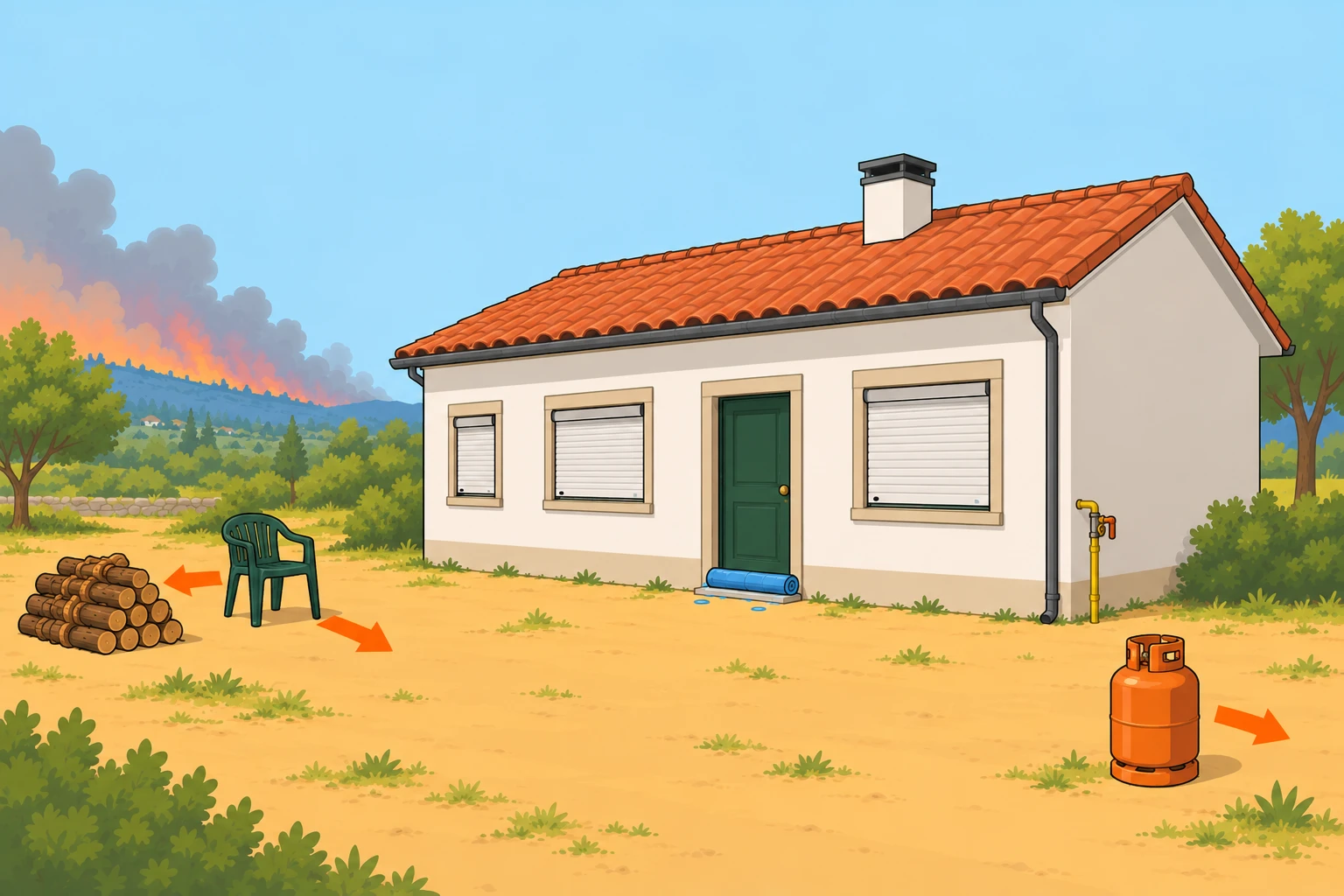
Doors, windows, shutters and vents. Wet towels in the gaps. Turn off the gas and move gas bottles, firewood, awnings and garden furniture away from the walls.
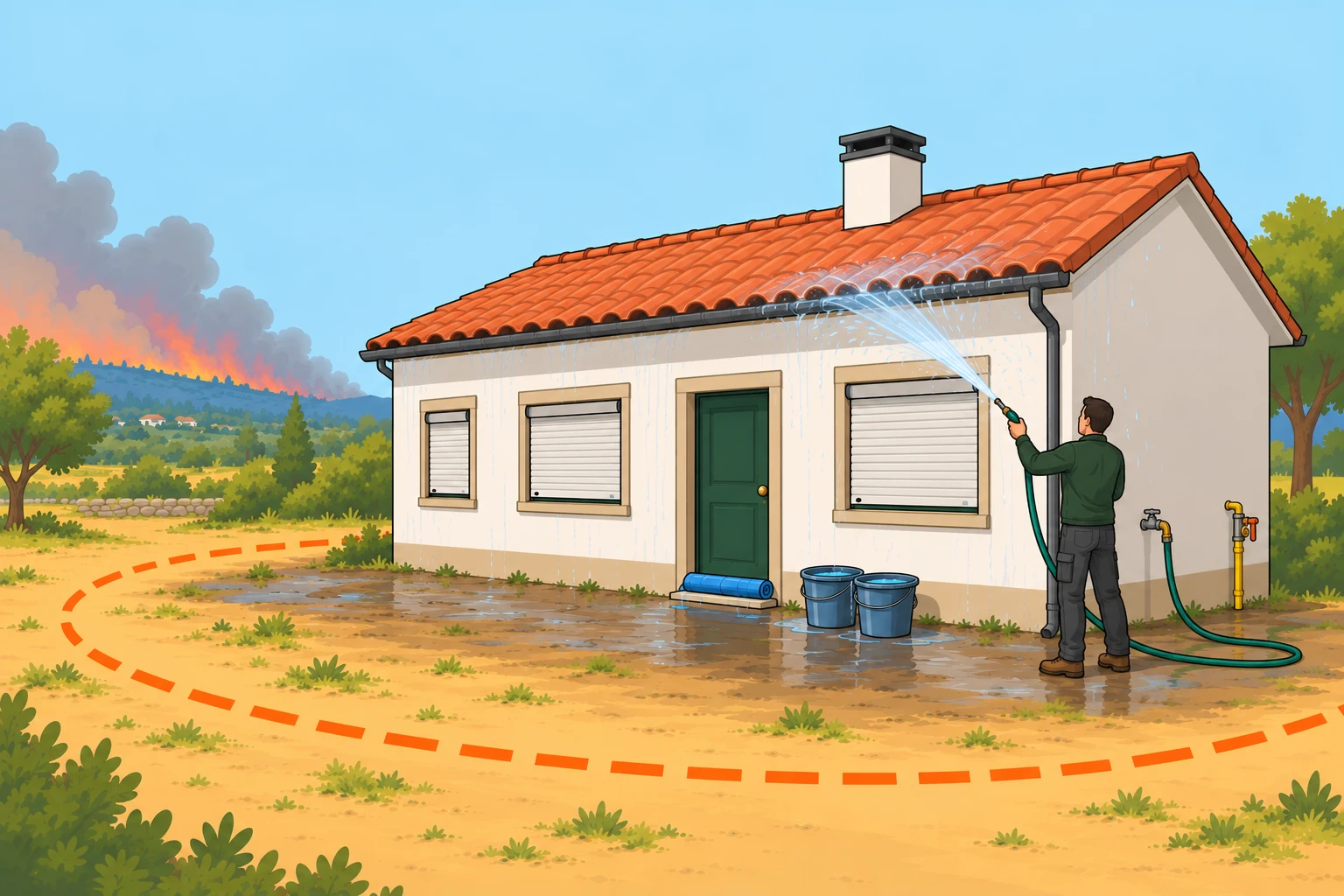
While it is safe to be outside, hose the walls, the roof and 10 m around the house. Fill buckets, the bath and the sink: you may need water afterwards.
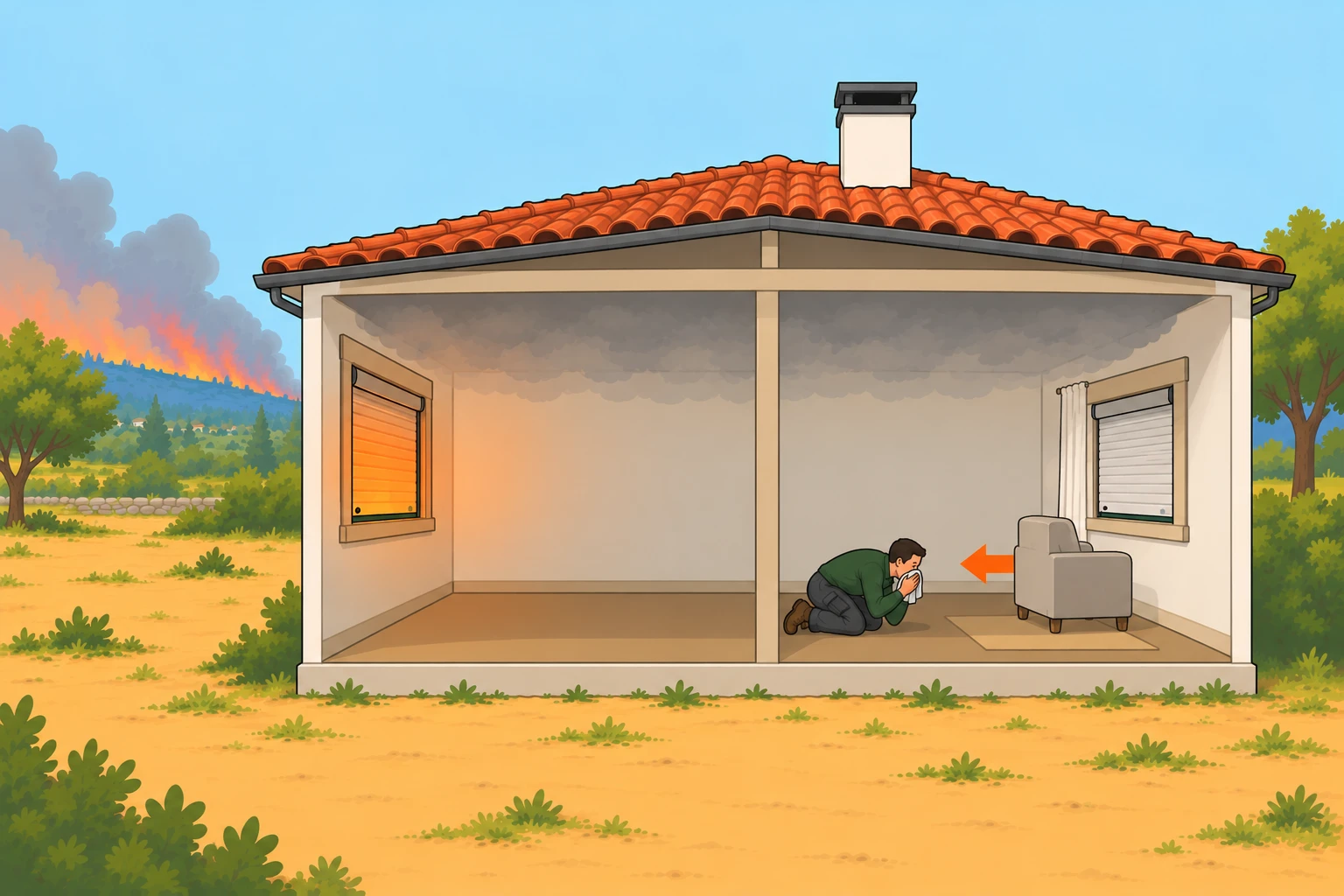
Inside, in the room on the side away from the fire, away from windows. Pull curtains and sofas away from the glass. If there is smoke, breathe close to the floor through a wet cloth.
Dress for the heat: long clothes in cotton or wool, sturdy closed shoes. Synthetic fabrics melt and stick to the skin.
Drink water often. Heat and effort dehydrate you fast.
Once the front has passed, go out carefully and look for spot fires: roof, gutters, loft, under the eaves, balconies, garden. Put them out straight away — and keep checking for several hours.
Stay informed by radio, and only take to the road when the authorities say it is safe.
An already burnt area, a ploughed field, a wide road or rock. Don't leave the trail. Cover your mouth and nose with cloth and don't stop where the fire can reach.
Stop away from trees and scrub, engine off, headlights and hazard lights on. Windows and vents closed. Get down below the windows and cover yourself with a wool blanket.
Go to the shelter or collective refuge set out by the parish under the Aldeia Segura (Safe Village) programme.
Close to the ground, through a wet cloth. Cover your head and body. Call 112 and say exactly where you are.
If you evacuate, take your pets. Livestock: open the gates early if you can't move them out.
“Fleeing by car is always the safest option.”
Only if you go early, on clear roads. With smoke and flames on the road, a car is a trap — as happened at Pedrógão Grande.
“While the flames are far away, there's time.”
In wind, embers fly well ahead of the fire and start new fires. Decide before you see flames.
“Opening windows lets the smoke out.”
It lets embers and heat in. Close everything and block gaps with wet towels.
“There'll be a fire engine at every door.”
In a big fire there aren't enough crews for every house at once. The cleared strip and your own preparation are the first defence.
“A small burn in winter is harmless.”
Many wildfires start from burns that got out of control. Always register it, and never burn in wind or high fire danger.
“Once the fire has passed, the danger is over.”
Embers on the roof, in the loft and in gutters can set the house alight hours later. Keep watch and put them out.
No equipment replaces a cleared 50 m strip. But a hose that reaches all round the house, a wool blanket in the car and a good smoke mask make a difference in the hours when the fire is close.
Amazon.es affiliate links. If you buy through them, K72+ earns a small commission at no extra cost to you. Learn more
Why: tem de chegar a toda a volta da casa para regar paredes, telhado e 10 m de terreno.
Why: no carro, é a proteção indicada contra o calor radiante se ficares cercado. Os tecidos sintéticos derretem.
Why: reduzem as partículas do fumo. Não protegem do monóxido de carbono: não servem para ficar no meio do fumo.
Why: para seguires os avisos e as ordens de evacuação quando a rede elétrica ou a de telemóvel caem.
Why: com fumo, a visibilidade cai a poucos metros. Mãos livres para regar, fechar e procurar focos.
With smoke and sirens you won't read a guide. Print this sheet, stick it inside the front door and agree two exit routes with your family.
Reviewed 5 Nov 2026 · Next review: Mar 2027 · Spotted a mistake? Tell us.
This guide does not replace instructions from the authorities or your municipality's or village's emergency plan. Always follow orders from Civil Protection, the GNR and firefighters. In an emergency, call 112.


