AntesSecção 02
Fixações anti-tombo para móveis
Why: cantoneiras ou fitas que prendem estantes, roupeiros e televisões à parede. É a medida que mais ferimentos evita.
Essential guide · Base level · 11 min
Portugal is an earthquake zone. This guide shows you how to prepare your home, protect yourself in the first seconds, escape a tsunami by the sea and act in the first hour after the shaking.

The essentials, in four points.
Drop, cover, hold on. On your knees, head and neck protected, under a sturdy table, until the ground stops.
towards the street or the stairs while the ground shakes. Trying to get out is how many people get hurt by glass and falling objects.
By the sea, a strong earthquake is the warning of a tsunami. The wave can arrive at once or up to about an hour later: walk to high ground without waiting for a siren.
of self-sufficiency at home: water, food, torch, battery radio and medicines. After a strong earthquake, help can take time.
The centre and south of mainland Portugal — Lisbon and the Tagus Valley, the Alentejo and the Algarve — have the highest seismic intensity, and that is also where most people live, along the coast. It is not a theoretical risk: Portugal's earthquake history is long and well documented.
No one can predict the day of an earthquake. What you can do is reduce what falls, know what to do in the first seconds and keep at home what you need for the days after — when water, power and communications may all fail at once.
| Year | Epicentre | Magnitude | What happened |
|---|---|---|---|
| 1755 | SW of Cape St Vincent | ≈ 8.75 | Lisbon destroyed, fires and tsunami |
| 1909 | Benavente | 6.7 | Destruction in Benavente and Samora Correia |
| 2024 | 60 km west of Sines | 5.3 | Felt from Leiria to Faro; no damage |
According to IPMA, the earthquake of 26 August 2024 was the 10th largest within 100 km of the epicentre since the 16th century, and produced the highest ground accelerations ever measured with modern instruments on the mainland. Sources: ANEPC and IPMA.
In a moderate earthquake most Portuguese homes stay standing. Injuries come mainly from their contents: toppling bookcases, televisions, pictures, glass, crockery. An afternoon with a drill solves most of the problem.
Fix to the wall bookcases, wardrobes, tall chests of drawers, the water heater and the TV. Use brackets or anti-tip straps screwed into the wall, not just into plasterboard.
Heavy things go low. Crockery, bottles, books and tools on the bottom shelves. Up high, only what is light and unbreakable.
Nothing heavy above the bed or the sofas: pictures, mirrors, shelves. It is where you spend the most hours defenceless.
Latches on cupboards in the kitchen and bathroom. Doors that swing open dump glass and cleaning products on the floor.
Learn how to shut off the main gas valve, the water stopcock and the electricity at the fuse box. Show everyone at home where they are.
Pick a shelter in every room: a sturdy table or desk, or a corner of an inside wall away from windows, mirrors and tall furniture.
Prepare your supplies and grab bag: water for 3 days, food that needs no fridge, torch, battery radio, whistle, medicines and copies of documents. Keep shoes and a torch by the bed.
An earthquake feels like a jolt followed by swaying, or like a dull rumble that grows. It usually lasts seconds — which feel like minutes. There is no time to think: the move has to be practised.
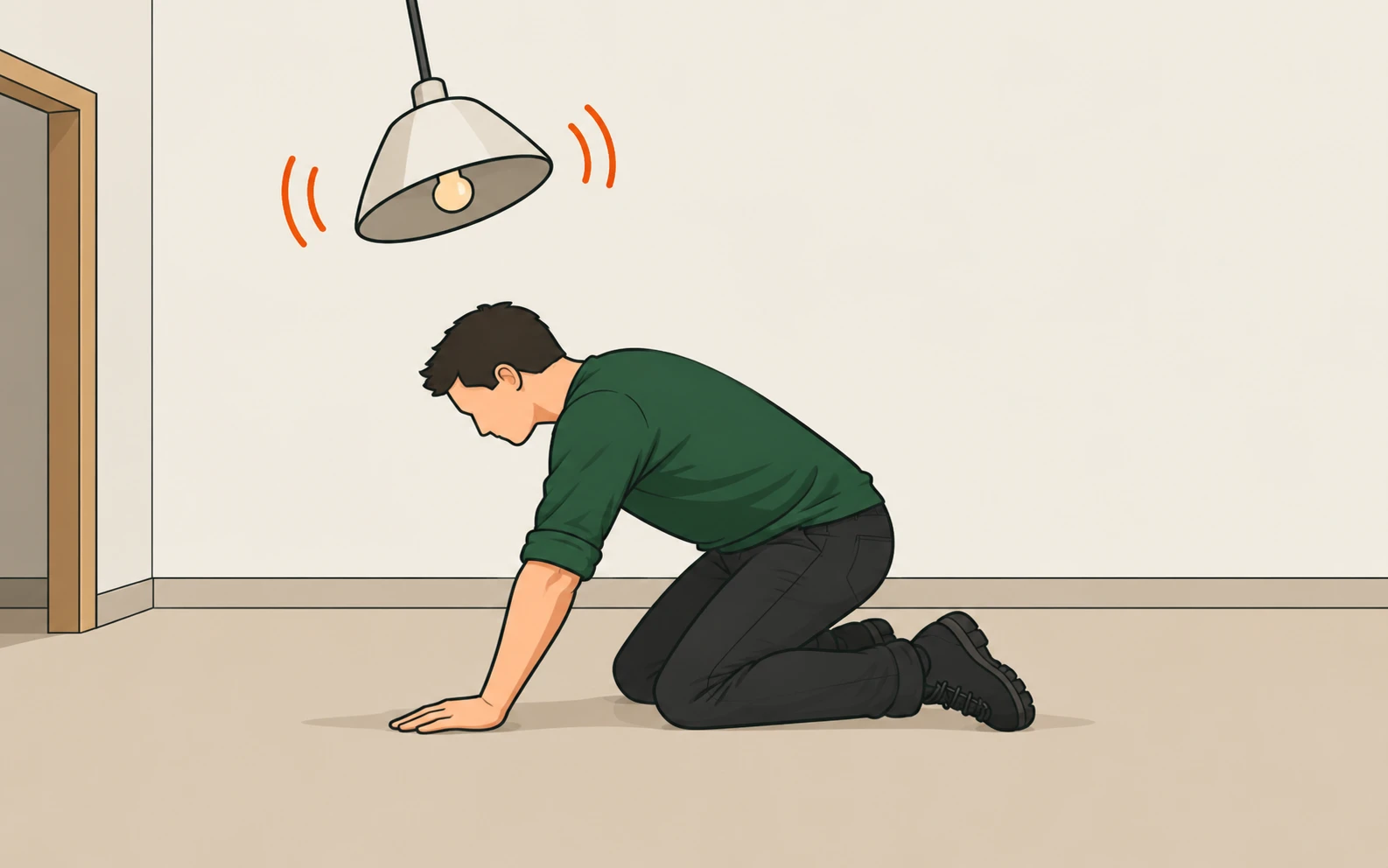
Get down on your knees before the shaking knocks you over. In this position you won't fall and you can still crawl to the nearest shelter.
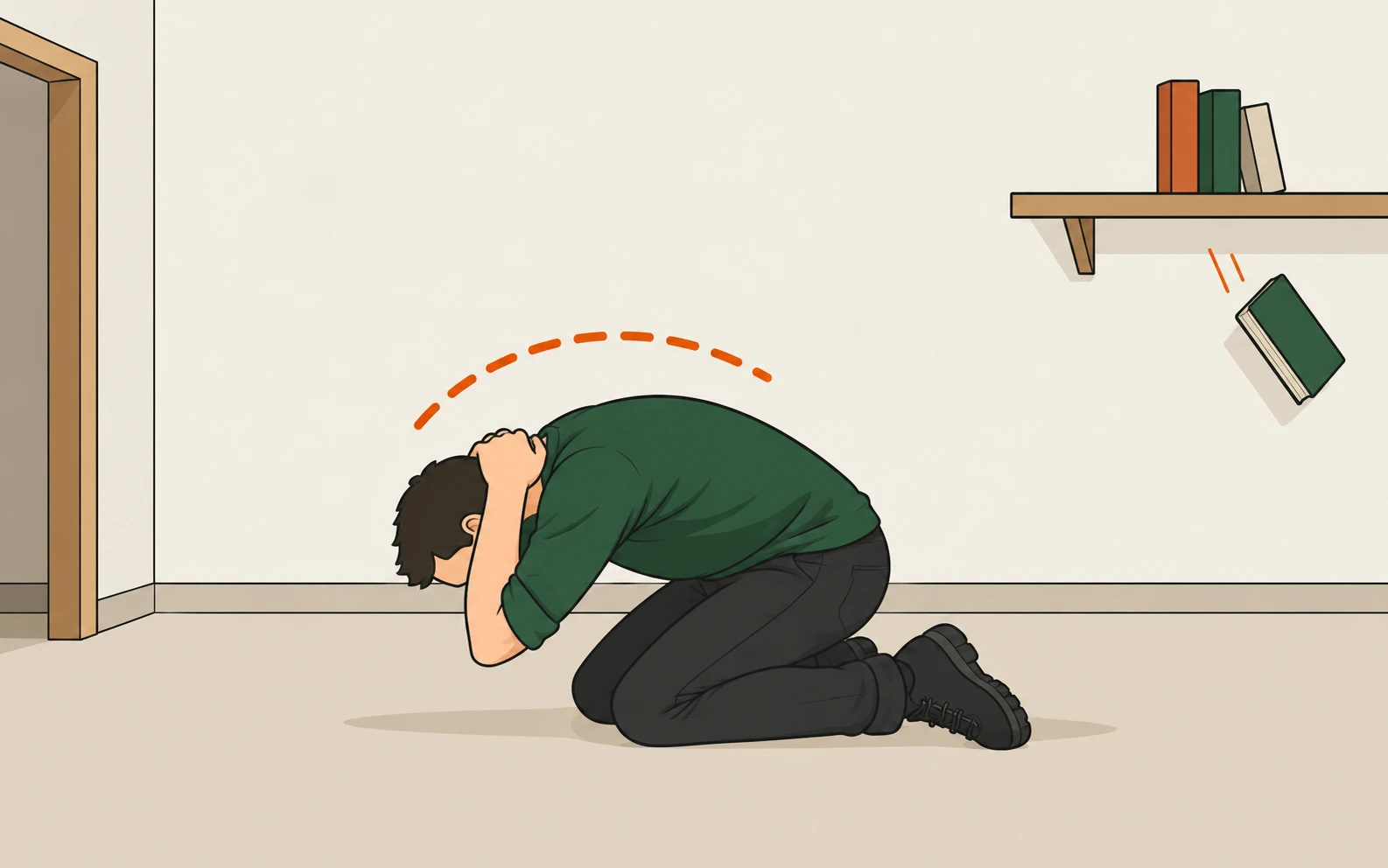
Protect your head and neck with your arms and hands. If there is a sturdy table nearby, get under it and hold on to one of its legs.
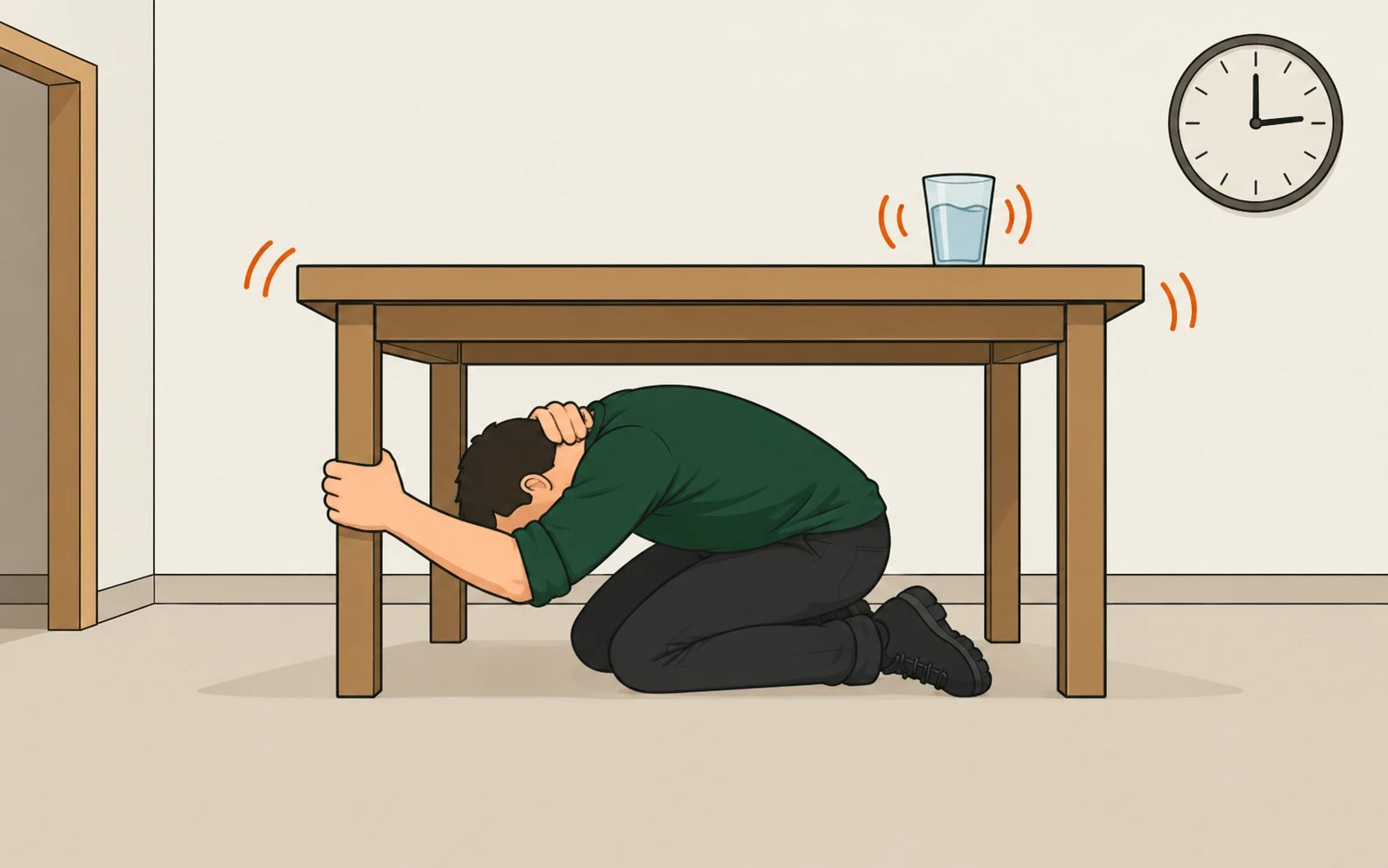
Stay like that until the ground stops. If the table moves, move with it. Only then get up — calmly, watching the floor and what's above you.
Don't run into the street or to the stairs. Never use the lift. Keep away from windows, mirrors and tall furniture.
Turn face down and protect your head and neck with the pillow until the shaking stops.
Move away from façades, balconies, poles, power lines and trees. Get down and protect your head.
Pull over away from bridges, flyovers, tunnels, buildings and poles. Handbrake on, seatbelt on, stay inside until it stops.
Protect yourself during the shaking. When it stops, leave on foot at once for high ground — see section 04.
The whole southern and western coast between Cape St Vincent and Peniche, and the estuaries and lagoons along it — such as the Tagus, the Sado and the Ria Formosa — are highly susceptible to tsunamis. In 1755 the tsunami surged up the Tagus estuary and struck Lisbon violently.
There are still no deep-ocean sensors in the North Atlantic: a tsunami is only confirmed when the first wave reaches a coastal tide gauge. That is why ANEPC is clear: the first sign is the earthquake itself. The wave can form straight away or up to about an hour later — and on some beaches the time to escape may be under 20 minutes.
Did you feel a strong or long earthquake while on the beach, by the sea or near an estuary?
Did the sea suddenly pull back, rise strangely, or do you hear a loud roar from the sea?
Did you get a Civil Protection text, hear a siren or an official warning?
The minutes after a strong earthquake are confusing: dust, car alarms, people in the street, phones without signal. Go in this order — people first, then the house, then information.
Put shoes on before you move. The floor will be covered in glass. Use a torch — never matches, lighters or candles.
Check for injuries at home and among neighbours. Don't move anyone seriously injured unless they are in immediate danger. Call 112 only for emergencies: the network gets overloaded.
Smell gas? Shut the main valve, open doors and windows, get out and report it. Don't switch lights on or off or use electrical appliances.
Wide cracks, leaning walls, damaged stairs? Leave the building by the stairs, calmly, with your grab bag. Never use the lift.
Expect aftershocks. They can be strong and bring down what was weakened. If you feel one, drop, cover and hold on again.
Get information by radio. A battery radio works when networks fail. Follow only official instructions and don't spread rumours.
Text, don't call, to tell your family you are safe — messages use far less network. Go to your agreed meeting point.
Don't trust tap water until you are told it is safe: pipes may have burst. Use your stored water — see the Water guide.
“The safest place is the “triangle of life”, next to a large piece of furniture.”
That is not what the authorities recommend. The official advice is drop, cover, hold on — ideally under a sturdy table.
“Run outside at the first jolt.”
During the shaking, going out exposes you to falling glass, façades and balconies. Stay inside, protected, until the ground stops.
“At the first jolt, rush to turn off the gas.”
Moving around during the shaking is risky. Protect yourself first; when the ground stops, check for a gas smell and shut the valve.
“Once the earthquake is over, the danger is over.”
Aftershocks, gas leaks, fires and weakened buildings cause many casualties in the hours that follow.
“If there's a tsunami, the sirens will sound.”
There may be no time and no warning. By the sea, a strong or long earthquake is reason enough to climb, without waiting.
“After the first wave you can go back to the beach.”
A tsunami is a series of waves lasting hours, and later ones may be bigger. Wait for the authorities.
Each item answers one of the steps in this guide. The essentials are cheap: anti-tip fixings for tall furniture, a torch by the bed and a battery radio. The rest — whistle, gloves, latches — makes the minutes after the shaking safer.
Amazon.es affiliate links. If you buy through them, K72+ earns a small commission at no extra cost to you. Learn more
Why: cantoneiras ou fitas que prendem estantes, roupeiros e televisões à parede. É a medida que mais ferimentos evita.
Why: impedem que as portas da cozinha e do quarto de banho se abram e despejem vidro e químicos no chão.
Why: mãos livres para te calçares, desceres a escada e veres feridos no escuro. Guarda uma junto à cama.
Why: recebe as indicações das autoridades quando a luz e as redes móveis falham.
Why: se ficares preso, um apito ouve-se muito mais longe do que a voz e gasta menos energia.
Why: para afastar vidros e destroços sem te cortares. Guarda-as na mala de emergência.
In an earthquake you won't read a guide. Print this sheet, stick it on the fridge or the front door and go over it with your family once a year.
Reviewed 5 Nov 2026 · Next review: Mar 2027 · Spotted a mistake? Tell us.
This guide does not replace instructions from the authorities or the emergency plan of your municipality, building, school or workplace. In an emergency, call 112.


