Essential guide · Base level · 11 min

Safe water when the tap fails

After an earthquake, a flood or a long blackout, mains water can stop — or arrive contaminated. This guide shows you how to store, assess and make safe the water your family needs.

Reviewed 5 Nov 2026
02·AHome water kit
A pot of water boiling on a gas hob
■ Storage: 20 L food-grade jerrycan■ Boil: 1 minute at a rolling boil■ Filter: 0.1 µm pore size■ Disinfect: 2 drops of bleach per litre

In 30 seconds

The essentials, in four points.

20 L

per person, at least. You use about 4 L a day — 2 for drinking, 2 for cooking and hygiene — so 20 L lasts 5 days.

1 min

at a rolling boil kills bacteria, viruses and parasites. It is the most reliable method there is.

2 drops

of plain bleach per litre, then wait 30 minutes. Cloudy or very cold water: 4 drops.

0.1 µm

is the pore size of a good portable filter. It stops bacteria and parasites — but not viruses.

01Why water comes first

Three days. That is how long the body lasts without water.

Anyone who has done survival training knows the rule: three minutes without air, three days without water, three weeks without food. In practice, in heat or with physical effort, dehydration starts to affect judgement and coordination long before that — exactly when you most need to think clearly.

In Portugal, the events that cut off or contaminate mains water are not theoretical. In every one of them, the water you have at home before the event is what counts. Everything else — filters, tablets, boiling — exists to stretch that reserve and to make safe the water you find afterwards.

Earthquake

Broken mains and reservoirs. Total loss of water, or water full of soil and debris when it comes back.

Flood

Intakes, wells and reservoirs contaminated with sewage. Do-not-drink notices that can last for days.

Long blackout

Without electricity, the pumps that push water to upper floors stop. People living high up lose pressure.

02How much to store — and where

At least 20 litres per person. Four a day.

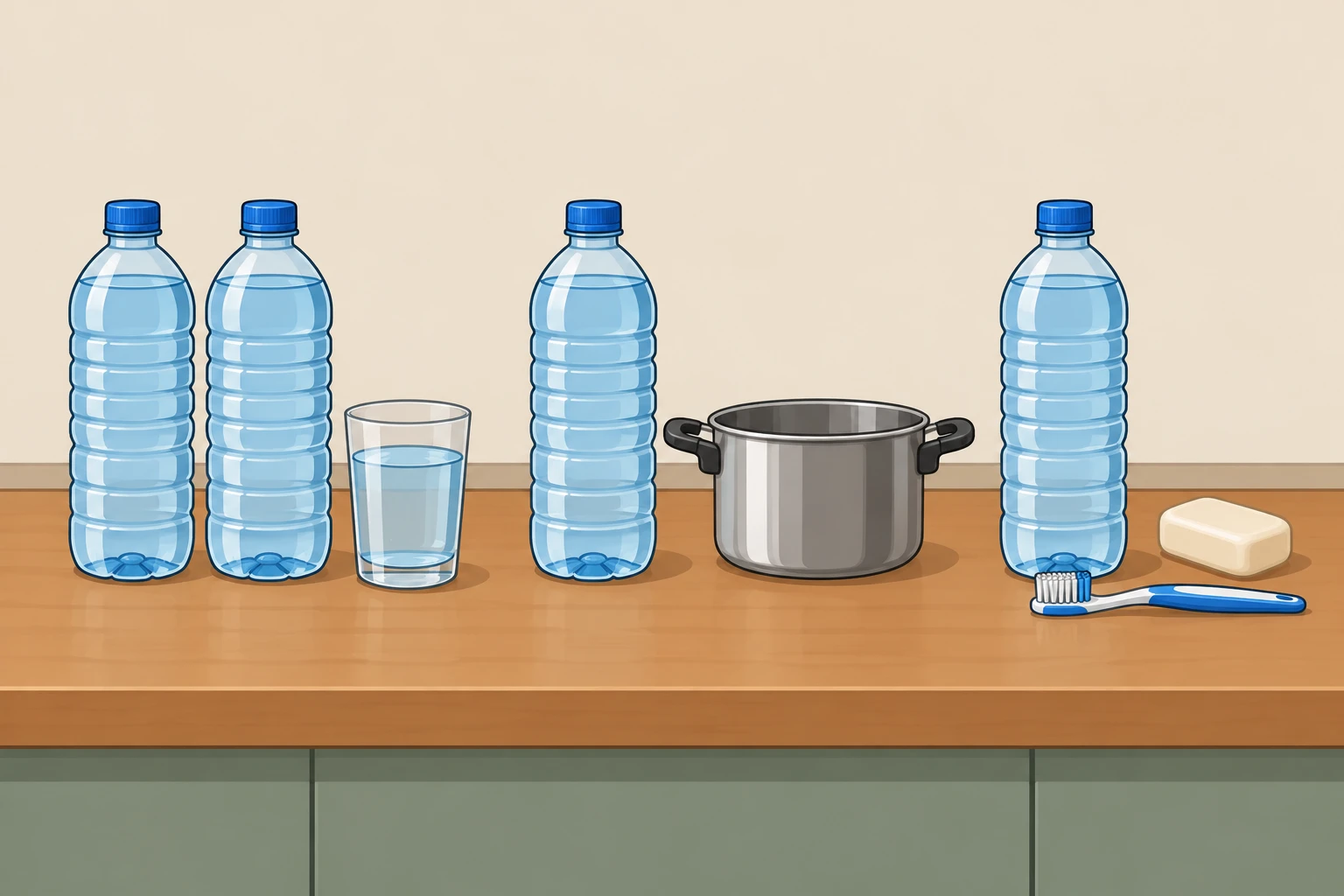
Four one-litre bottles: two next to a glass (drinking), one next to a pot (cooking) and one next to a toothbrush and soap (hygiene)Drinking · 2 LCooking · 1 LHygiene · 1 L
Per person, per day. Source: CDC.

The international reference is about 4 litres per person per day: 2 for drinking and the rest for cooking and basic hygiene. Since 2025 the European Commission has recommended that every household be self-sufficient for at least 72 hours. Count your pets too, and store more in hot weather or if there are babies, pregnant women or sick people at home.

Recommended reserve (litres)
People at homeMinimum (5 days)7 days14 days
1 person202856
2 people4056112
3 people6084168
4 people80112224
5 people100140280

Minimum: 20 L per person (4 L a day for 5 days). Example: family of 4 = 80 L → four 20 L jerrycans.

Sample labelDrinking waterFilled: 28/09/2026Replace by: 03/2027Source: mains
1

Sealed bottled water is the simplest option. Respect the use-by date and keep it out of the sun.

2

For tap water, use food-grade jerrycans — look for the glass-and-fork symbol. Never bottles that once held milk, juice or chemicals.

3

Somewhere cool and dark, away from fuel, paint and cleaning products: plastic lets smells and vapours through.

4

Label it with the date and replace stored tap water every 6 months. Use the old water for plants and refill.

5

Split the reserve. A 20 L jerrycan weighs 20 kg. Keep small bottles ready for the emergency bag too.

03What can be in the water

Know the enemy: five threats, very different sizes.

Not all suspect water has the same problem, and each treatment method only works on some threats. Understanding this is what separates people who treat water properly from people who merely feel safe.

> 10 µm

Sediment

Soil, sand, organic matter. It hides microbes and cancels out chlorine and sunlight.

1–15 µm

Protozoa

Giardia and Cryptosporidium. Common in streams and after floods. Cryptosporidium resists chlorine.

0.2–10 µm

Bacteria

E. coli, Salmonella. They cause severe diarrhoea and are the main risk in sewage-contaminated water.

0.02–0.3 µm

Viruses

Norovirus, hepatitis A. So small they pass through portable filters.

Dissolved

Chemicals

Fuel, pesticides, metals. They cannot be filtered or boiled out at home.

Plate 02·B — What each method stopsSize in micrometres · logarithmic scale
0.010.1110100 µmTHREATViruses0.02–0.3Bacteria0.2–10Protozoa1–15 · Giardia, CryptoSediment> 10METHODCloth / coffee filtersediment only →Portable filter 0.1 µmviruses passBoiling · 1 minall microbesBleach (chlorine)Giardia yes, Crypto noChlorine dioxideall · Crypto in 4 hSun (SODIS): kills microbes in clear water after 6 h of direct sun. · Dissolved chemicals: no home method works — do not use the water.
Filters work like a net: they stop anything larger than the pore. Boiling and chemicals do not depend on size — they attack the microbes directly. Source: CDC, Make Water Safe During an Emergency.
04The three-step method

Clarify. Disinfect. Store. Always in that order.

Whatever your equipment, the sequence is the same. Skipping the first step is the most common mistake: cloudiness shields microbes from chlorine and sunlight, and clogs a filter in minutes.

Glass of cloudy water with sediment
Step 1

Clarify

Let it settle for at least 30 minutes. Slowly pour off the top through a folded cotton cloth or a coffee filter.

Pot of water at a rolling boil
Step 2

Disinfect

Pick one of the five methods below, depending on what you have and where the water came from. When in doubt, boil.

Capped water jugs lined up
Step 3

Store

Clean, covered container, labelled with the date. Serve with a tap or a clean ladle — never dip cups or hands in.

Five ways to disinfect

From most reliable to last resort
A

Boil

Most reliable
  1. If it is cloudy, clarify it first.
  2. Bring it to a rolling boil — large, continuous bubbles, not just small bubbles at the bottom.
  3. Keep it there for 1 minute. Above 2000 m, 3 minutes (in mainland Portugal even the highest point, Torre at 1993 m, is below that).
  4. Let it cool covered. To remove the flat taste, pour it back and forth between two clean containers.
Removes
Bacteria, viruses and parasites
Time
≈ 10 min + cooling
You need
Heat, fuel, pot with a lid
Caution
Uses fuel — include it in your reserve. Does not remove chemicals.
B

Bleach

In every home
  1. Use plain bleach: unscented, no detergent, not a gel. Check the label says sodium hypochlorite.
  2. Clear water: 2 drops per litre (5–9% bleach). Cloudy, coloured or very cold: 4 drops. If the label says less than 5%, double it.
  3. Stir and wait 30 minutes.
  4. It should smell slightly of chlorine. If it does not, repeat the dose and wait another 15 minutes.
Removes
Bacteria, viruses, Giardia
Time
30 min
You need
Plain bleach and a dropper
Caution
Does not kill Cryptosporidium. Bleach loses strength: replace the reserve bottle every year.
C

Tablets

For the emergency bag
  1. Prefer chlorine dioxide: it is the only chemical that also kills Cryptosporidium.
  2. Use the dose on the pack — usually 1 tablet per litre.
  3. Wait 30 minutes for bacteria, viruses and Giardia; 4 hours if the water comes from a river or stream.
  4. Iodine tablets: avoid in pregnancy or with thyroid problems, and do not use for more than a few weeks.
Removes
All microbes (chlorine dioxide)
Time
30 min to 4 h
You need
Tablets within their use-by date
Caution
Silver-only tablets (“Classic” type) do not disinfect: they only preserve water that is already safe.
D

Portable filter

Instant, no chemicals
  1. Choose a filter with a pore size of 0.1 µm or smaller (the CDC requires 0.3 µm at most for bacteria).
  2. Fill the pouch with the least cloudy water and squeeze it or hang it (gravity) over a clean container.
  3. After each use, backflush it with the syringe supplied with the filter.
  4. Never let it freeze: ice breaks the fibres without any visible sign.
Removes
Bacteria and parasites
Time
Instant
You need
Filter and a clean container
Caution
Does not stop viruses. After floods or near sewage, filter and then disinfect.
E

Sun (SODIS)

When nothing else is left
  1. Clear PET bottles, up to 2 L, labels removed. Clear water only.
  2. Fill three quarters, shake for 20 seconds, then top up.
  3. Lay the bottles in the sun, ideally on a metal sheet or light surface.
  4. Leave for 6 hours in direct sun, or 2 days if it is overcast.
Removes
Most microbes
Time
6 h to 2 days
You need
PET bottles and sun
Caution
Does not work with cloudy water, glass or coloured bottles, or in continuous rain.
Quick comparison
MethodBacteriaVirusesGiardiaCryptoChemicalsTime
A · Boil● Yes● Yes● Yes● Yes○ No10 min
B · Bleach● Yes● Yes● Yes○ No○ No30 min
C · Chlorine dioxide● Yes● Yes● Yes● Yes · 4 h○ No30 min–4 h
D · 0.1 µm filter● Yes○ No● Yes● Yes○ NoInstant
E · Sun (SODIS)● Yes● Yes● Yes◐ Partial○ No6 h–2 days
Sand and charcoal filter○ No○ No○ No○ No◐ SomeClarifies only
05Which method to use?

Decide in 20 seconds.

Three questions, in the right order. The first is the most important: some water cannot be made safe by any home method.

1

Does it smell of fuel or chemicals, or have foam or an oily film?

Yes
Do not useNo home method removes chemicals. Find another source.
No
2

Is it cloudy or does it have visible particles?

Yes
Clarify firstLet it settle 30 min and pour through a cloth. Then go to question 3.
No
3

Could it have been in contact with sewage? Floods, flooded wells, near septic tanks.

Yes
Double treatmentFilter (0.1 µm) and disinfect: boil, bleach or chlorine dioxide.
No
One method is enoughBoil, bleach, tablets or filter. Then store it covered and labelled.
06Eight costly mistakes

Myths that still circulate — and what to do instead.

Myth

“If it is clear, it is safe to drink.”

Microbes are invisible. Crystal-clear spring water can carry Giardia.

Myth

“A sand and charcoal filter makes water drinkable.”

It only clarifies and improves the taste. You still have to disinfect afterwards.

Myth

“Taste a little to see if it is OK.”

Never. A small amount is enough to cause an infection, and taste does not reveal microbes.

Myth

“Boiling fixes everything.”

It fixes microbes. Fuel, pesticides and metals stay — and boiling even concentrates them.

Myth

“Any bleach will do.”

Only plain bleach. Scented, detergent or gel bleaches contain additives that are not meant to be drunk.

Myth

“Silver tablets disinfect river water.”

Silver-only tablets preserve water that is already safe. To disinfect, use chlorine or chlorine dioxide.

Myth

“An old juice bottle is fine for storage.”

Residues feed bacteria. Use new, food-grade containers.

Myth

“With a portable filter I am safe after a flood.”

Portable filters do not stop viruses. After floods, filter and disinfect.

07Recommended equipment

The water kit for this guide, step by step.

Each item was chosen for the job it does in one of the steps above — not for the brand. You do not need all of it: a jerrycan, plain bleach and a pot already cover the essentials. The rest gives you more options and more autonomy.

Amazon.es affiliate links. If you buy through them, K72+ earns a small commission at no extra cost to you. Learn more

GuardarPasso 3

Jerricã alimentar 20 L com torneira

Why: plástico próprio para água potável; a torneira evita contaminar a reserva ao servir. Procura o símbolo do copo e garfo.

View on Amazon.es
GuardarPasso 3

Katadyn Micropur Classic

Why: iões de prata que mantêm a água da reserva em boas condições até 6 meses. Não desinfeta — só conserva.

View on Amazon.es
ClarificarPasso 1

Balde alimentar com tampa, 10–15 L

Why: para deixar a água assentar antes de a tratar. Tampa e plástico alimentar evitam nova contaminação.

View on Amazon.es
DesinfetarMétodo C

Pastilhas de dióxido de cloro

Why: o único químico que elimina também o Cryptosporidium. Leves e pequenas, ideais para a mala de emergência.

View on Amazon.es
DesinfetarMétodo B

Frascos conta-gotas

Why: para dosear a lixívia gota a gota, sem adivinhar. Rotula um frasco “só lixívia” e guarda-o com a reserva.

View on Amazon.es
FiltrarMétodo D

Sawyer Squeeze

Why: fibra oca de 0,1 µm, cabe na mão e trata milhares de litros. Alternativa mais simples: palhinha LifeStraw.

View on Amazon.es
FiltrarMétodo D

Filtro de gravidade 3–6 L

Why: para uma família. Penduras o saco e a água filtra sozinha, sem apertar, enquanto tratas de outras coisas.

View on Amazon.es
FerverMétodo A

Fogareiro de campismo a gás

Why: para ferver sem eletricidade nem gás da rede. Junta cartuchos extra e uma panela com tampa.

View on Amazon.es
Quick card

Print it. Stick it on the fridge.

In an emergency you will not want to look this up on your phone — which may have a flat battery. Print the card and stick it on the fridge or inside the lid of your emergency bag.

Water · K72 card
1Store at least 20 L per person (4 L a day: lasts 5 days).
2Smells of fuel or chemicals? Do not use.
3Cloudy? Settle 30 min and pour through a cloth.
4Boil 1 min — or 2 drops of bleach/L and wait 30 min.
5After floods: filter and disinfect.
6Replace stored tap water every 6 months.
02·A · k72plus.comEMERGENCY: 112
Sources and review
  1. CDC — How to Make Water Safe in an Emergency — boiling, bleach doses, filters, SODIS
  2. DGS (Portuguese Directorate-General of Health) — Food and water
  3. European Commission — Preparedness Union Strategy (2025) — 72-hour self-sufficiency recommendation
  4. Katadyn manufacturer instructions for Micropur tablets

Reviewed 5 Nov 2026 · Next review: Mar 2027 · Spotted a mistake? Tell us.

This guide does not replace official guidance. If there is a do-not-drink notice in your area, follow the instructions of your water utility and health authority. In an emergency, call 112.

Continue in module · Water

View module →