LonaSecção 04
Lona leve 3 × 3 m
Why: o abrigo mais rápido: cabe na mochila e monta-se em minutos.
Essential guide · Base level · 7 min
Hypothermia can happen above 4 °C if you're wet. Getting out of wind and rain, insulating from the ground, choosing a safe site and pitching a tarp shelter — and what Portuguese law says about camping.

The essentials, in four points.
Hypothermia doesn't need snow: it can happen above 4 °C (40 °F) if you're wet from rain, sweat or falling into water.
Cold ground steals heat fast. A mat, backpacks, branches or dry leaves between you and the ground matter as much as a roof.
Never in a stream bed or right by water that can rise. Away from dead trees and broken branches, and off ridges in a thunderstorm.
Stoves, heaters and gas lanterns inside a tent or closed shelter produce carbon monoxide, which kills while you sleep.
A walk that runs late, a twisted ankle at dusk, a car stuck on a mountain road. You don't need snow: rain, wind and a night at 5 or 10 °C are enough for your body to lose heat without you noticing.
An emergency shelter isn't a cabin. It's whatever gets you out of the wind and rain and off the cold ground, as fast as possible, with what you have on you.
Lost or injured on a walk. Stop, call 112, stay visible and protect yourself from wind, rain and the ground.
On a road cut off by snow or a flood. As a rule, stay in the car: it's the best shelter you have.
In a winter blackout, your home is the shelter. The Extreme heat and cold at home guide explains how to keep it warm.

Behind a rock, a wall, a bank or under a tarp. Wind and wet clothing chill you fastest.

Sit or lie on a mat, your backpack, coiled rope, branches or dry leaves. Never directly on earth, rock or snow.

Take off wet clothes if you have dry ones. Put on layers, cover your head and neck, and use the foil blanket over everything.
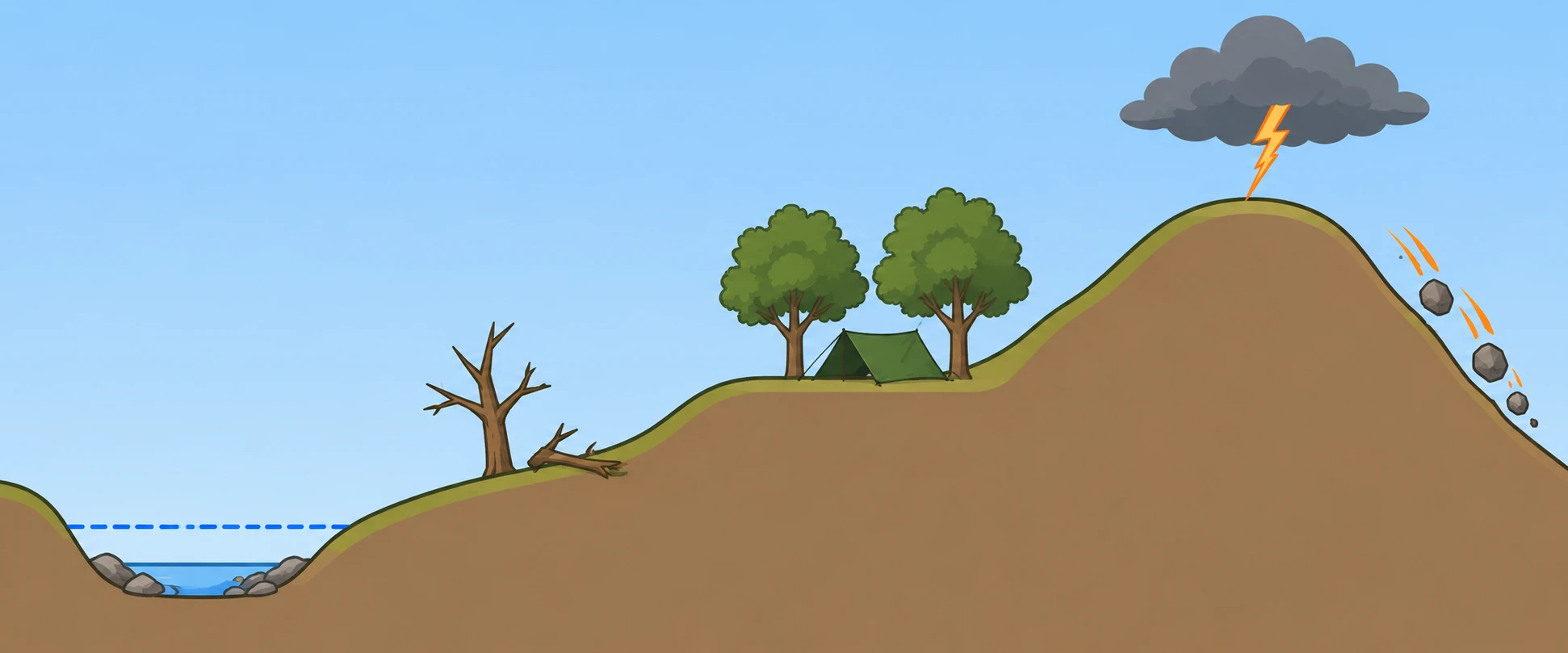 Stream bedThe water can riseDead treeGood spot · flat, above the waterRidge in a stormLoose rocks
Out of stream beds and gullies, and above the level the water can reach. A downpour in the hills can make a stream rise in minutes.
Look up: dead trees, hanging broken branches and loose rocks can fall at night or in the wind.
In a thunderstorm, nowhere outdoors is safe. Get into a building or a hard-topped car. A tent gives no protection from lightning. Avoid ridges, open fields, isolated trees and water.
Stay visible and close to where you said you'd be: that's where they'll look for you.
Stretch a rope between two trees at waist height and put the tarp over it.
Fix the corners to the ground with pegs, stones or cord. For a lean-to, the low side faces the wind and rain.
Underneath, the insulating layer: a mat, your backpack or dry leaves. Without it, the ground keeps stealing your heat.
Practise at home or in a park before you need it. Pitching a tarp with cold hands in the dark is much harder.
“Hypothermia only happens below freezing.”
Wet and in the wind, it can happen above 4 °C.
“A good shelter is a hut made of branches.”
It takes hours and a lot of energy. First get out of wind and rain and insulate yourself from the ground with what you have.
“Next to the stream is best: there's water.”
Water can rise suddenly. Shelter above and away from the stream bed.
“In a tent I'm safe from lightning.”
A tent gives no protection from lightning. Get into a building or a hard-topped car.
“A stove inside the tent warms the night.”
It produces carbon monoxide. Stay warm with clothing, a sleeping bag and ground insulation.
“A foil blanket solves everything.”
It helps, but without protection from wind and ground it loses much of its effect. It's an extra layer, not a shelter.
A light tarp, cord, a sleeping mat and a foil blanket fit in a day pack and turn a dangerous night into an uncomfortable one.
Amazon.es affiliate links. If you buy through them, K72+ earns a small commission at no extra cost to you. Learn more
Why: o abrigo mais rápido: cabe na mochila e monta-se em minutos.
Why: isola do chão frio, que é o que mais calor rouba.
Why: uma camada extra por cima da roupa, protegida do vento.
Why: para esticar a lona e prender os cantos.
Keep it in your day pack and grab bag.
Reviewed 5 Nov 2026 · Next review: Mar 2027 · Spotted a mistake? Tell us.
This guide does not replace mountain training or local rules. In an emergency, call 112.