ComunicarSecção 02
Rádios PMR446 (par)
Why: falam entre si sem rede móvel e sem licença, a distâncias curtas. Úteis para a família se coordenar numa evacuação.
Essential guide · Base level · 8 min
Meeting points, an out-of-area contact, who does what, school, children, older people and pets — and how to practise the plan as a family.

The essentials, in four points.
to meet: one near home, at a safe distance, and one outside the neighbourhood, for when you can't get back home.
outside the area — a relative or friend in another region — whom everyone knows by heart. Everyone tells that person where they are.
Children must know how and when to call 112, their home address and one adult's number by heart.
A plan that has never been practised is forgotten in the first minute. Practise leaving home together at least once a year.
Emergencies rarely catch the family together: the children are at school, the parents at work, the grandparents at home. Mobile networks get overloaded or stop working — as happened in the blackout of 28 April 2025. Without a plan agreed beforehand, everyone improvises, and families lose precious hours looking for each other.
A family emergency plan is a set of decisions made today, calmly, so you don't have to make them under pressure. It takes no more than an hour and fits on one sheet of paper.
Everyone somewhere else: school, work, on the move. The plan says where to meet and who collects whom.
Everyone asleep, in the dark. The plan says which way out, who helps the youngest and where to gather outside.
Phones with no signal or battery. The plan says what each person does without needing to talk to anyone.
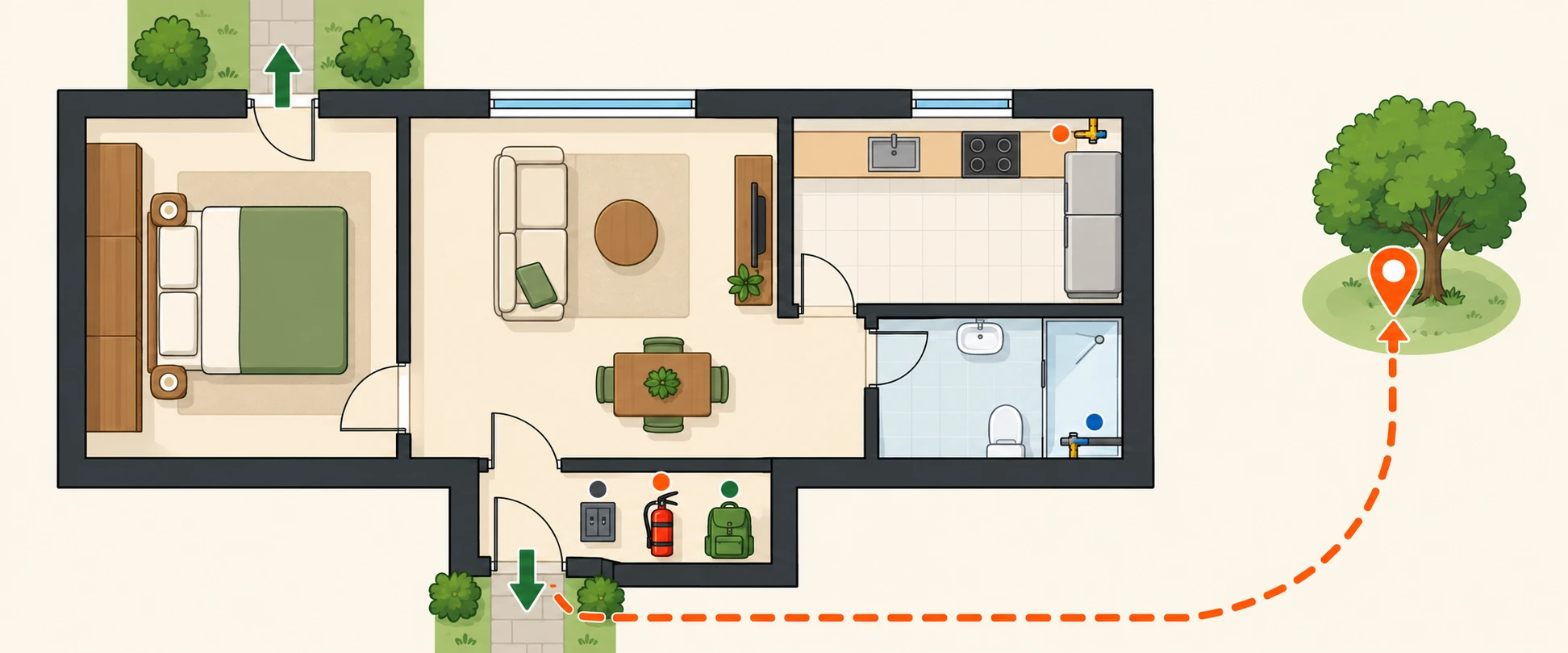 Exit 2Exit 1GasWaterPanel · extinguisher · bagMeeting point
The risks where you live. Ask your municipal civil protection service which risks are most likely where you live — earthquake, flood, wildfire, industrial accident — and read this site's guide on each.
Two meeting points: one near home, outside the building, at a safe distance (a park, a square); another outside the neighbourhood, for when you can't get back home.
One out-of-area contact: someone in another region, less likely to be affected. Everyone texts them where they are. Write the number on paper, in everyone's wallet.
Who does what: who turns off the gas, water and electricity; who takes the bags; who looks after the youngest and the pets; who checks on the elderly neighbour.
The ways out: two exits from home if possible, and two routes out of the neighbourhood — one may be blocked. Mark them on a paper map.
Health and documents: each person's allergies, conditions, medicines and doses, family doctor, copies of documents and insurance. A copy goes in the grab bag.
Ask the school or nursery what they do in an emergency, where they take the children and who may collect them. Leave written authorisation for a second adult.
Use simple words and focus on what to do, not what might happen. A card in their bag with name, contacts and meeting point. Teach them when to call 112.
Who helps them out and which way. If they live alone, arrange it with a trusted neighbour and leave them a family contact.
Portugal's MAI112 app lets you reach 112 by video call with a Portuguese Sign Language interpreter, or by text. Install and test it beforehand.
Check with the council whether the municipal shelter takes pets, and arrange an alternative: relatives, friends, pet-friendly accommodation.
A plan only works if everyone knows it without reading it. Practice doesn't need to be dramatic: ten minutes, done calmly and with the children taking part, is enough.

A family conversation to decide the six elements. Write everything on one sheet and stick it on the fridge. Everyone says, in their own words, what they'll do.

Leave home as if it were real — with the bags, the pets and in the dark, at least once. Time it and walk to the meeting point.

What went wrong? Has anything changed — school, work, phone numbers, someone new at home? Update the sheet and the app.
| When | What to practise | Guide |
|---|---|---|
| March | Check the grab bag and home supplies | Grab bag |
| April | Clear the 50 m strip around the house | Wildfire |
| June | Agree how to look after grandparents in a heatwave | Heat and cold |
| September | Unblock drains and gutters before the rains | Floods |
| October | Check the grab bag; practise leaving home in the dark | Blackout |
| Autumn | National “A Terra Treme” drill: drop, cover, hold on | Earthquake |
A calendar suggested by K72+. The “A Terra Treme” drill is run every year by ANEPC.
“In an emergency, we'll just call each other.”
Networks get overloaded or go down. That's why meeting points and an out-of-area contact are agreed beforehand.
“Talking about this scares children.”
Children who know what to do cope better with fear. Speak calmly, focus on action and turn practice into a game.
“We have everything in the family group chat.”
With no battery or signal, there is no group. Meeting points and contacts learned by heart, and on paper.
“The school will take care of everything.”
The school has its own plan, but you need to know what it is and who may collect your children.
“The plan is only for people in risk areas.”
Blackouts, house fires and storms happen everywhere. The plan is the same; only the risk changes.
“Once it's done, it's done.”
People change school, job and phone. Review the plan once a year, when you check the grab bag.
A family plan is made with pen and paper. These items help put it into practice when networks fail: radios that need no network, whistles for the children and pouches for the plan's documents.
Amazon.es affiliate links. If you buy through them, K72+ earns a small commission at no extra cost to you. Learn more
Why: falam entre si sem rede móvel e sem licença, a distâncias curtas. Úteis para a família se coordenar numa evacuação.
Why: um em cada mochila, sobretudo das crianças: ouve-se muito mais longe do que a voz.
Why: para a cópia do plano, dos documentos e dos contactos que vai em cada mala.
Why: marca-o na planta de casa e ensina toda a família a usá-lo.
Fill in this sheet with the whole family, stick it on the fridge and put a copy in every grab bag.
Reviewed 5 Nov 2026 · Next review: Mar 2027 · Spotted a mistake? Tell us.
This guide does not replace instructions from the authorities or the emergency plans of your municipality, school or workplace. In an emergency, call 112.
